How Altitude, Sunlight, and Rainfall Shape Tobacco Aroma
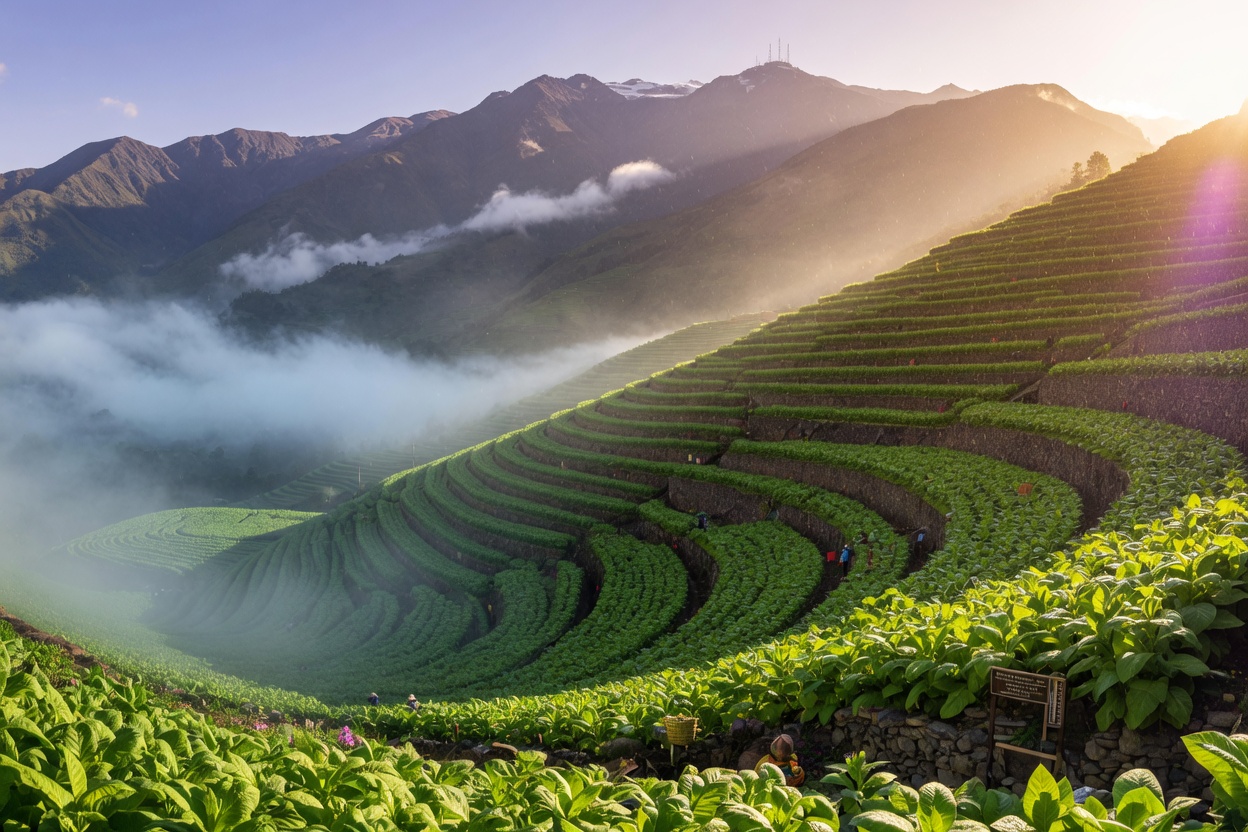
When discussing tobacco "aroma," marketing copy often tosses out a few geographical labels: highlands, abundant sunshine, ample rainfall, unique terroir. These words are not entirely nonsense — altitude, sunlight, and rainfall do reshape the chemical profile of tobacco leaves in the field — but neither are they fixed recipes on a spice bottle. What truly works is a more dispassionate chain:
Environmental inputs (light, temperature, water, air pressure, UV) → Plant photosynthesis and stress response → Sugars, nicotine, organic acids, polyphenols, carotenoids, and nitrogenous compounds in leaves → Curing (flue-curing/air-curing/sun-curing/fermentation) fixation and reconversion → "Aroma" recognized by the senses upon combustion or heating
This article explains from the perspectives of agroecology and tobacco chemistry how these three environmental factors shape aroma precursors and final expression, with specific production region/cultivation examples for comparison. First, four boundaries:
- Environment is a shaping force, not an identity card. At the same altitude, slope aspect, soil nitrogen, variety, and stalk position can produce vastly different results.
- Field precursors ≠ smoke aroma. Much "aroma" is a product of curing and pyrolysis; more rain does not directly make smoke taste like "water."
- The ecological logic differs for cigar wrapper, flue-cured, sun-cured/oriental, and burley tobaccos. The following text will present them side by side but will indicate their uses to avoid lumping them together.
- Understanding terroir does not mean picking a "better-smelling/better-smoking" tobacco. Any combustible tobacco product produces tar, carbon monoxide, multiple carcinogens, and irritant gases; popular science about producing regions does not change the health risk reality.
I. From Field to Nose: The Three Layers of Aroma
To clarify "altitude/sunlight/rainfall," we first break down "aroma":
| Layer | Primary Stage | Typical Chemical Objects | Common Sensory Descriptions |
|---|---|---|---|
| Field Metabolism Layer | Growth and maturation | Reducing sugars and total sugars, nicotine, organic acids, polyphenols/flavonoids, carotenoids, amino acids/proteins, pigments | Sweetness potential, strength potential, green/off-flavor risk, oil content, and "body" |
| Curing Transformation Layer | Flue-curing, air-curing, sun-curing, fermentation/aging | Maillard reaction-related compounds, carotenoid degradation products, sugar-nitrogen ratio changes, formation/loss of some volatiles | Toasty-sweet, nutty, hay, aged character, off-flavor reduction or increase |
| Pyrolysis/Heating Presentation Layer | Combustion or heating | Phenols, carbonyls, nitrogenous heterocycles, tar components, and other complex mixtures | Woody, spicy, charred, harsh, aftertaste |
Environmental factors primarily reshape the raw material profile of the first layer; curing determines how much of that profile is retained, transformed, or destroyed; the final layer is what you smell or taste. Therefore, when this article discusses "aroma," it mostly refers to: how the environment pushes tobacco leaves toward a particular precursor and structural framework, making certain aroma types more likely to emerge.
II. Altitude: How Elevation Reshapes Light, Temperature, Water, and Secondary Metabolism
Altitude itself is not a "spice"; it is a bundle of climatic parameters:
- Mean temperature and growing season length changes
- Diurnal temperature range (DTR) often increases with altitude
- Lower atmospheric pressure, thinner air
- Enhanced ultraviolet radiation (especially UV-B)
- Precipitation patterns and cloud frequency may change (vast differences between windward and leeward slopes in mountainous regions)
1. Diurnal Temperature Range and "Sugar Retention"
Plants accumulate carbohydrates through photosynthesis during the day and consume some through respiration at night. In suitable plateau environments with a large diurnal range, nighttime temperatures are lower, respiration consumption is relatively reduced, favoring the retention of carbohydrates such as total sugars and reducing sugars — this is an important physiological background for understanding why plateau tobacco regions like Yunnan, China, are often described as having "good sweetness foundation and rich aroma substances."
It must be emphasized:
- A large diurnal range favors the trend toward sugar retention, but does not mean "higher altitude always equals higher sugar." Excess nitrogen fertilizer, severe drought, disease, or overly late harvesting can all alter the sugar-nicotine ratio.
- Sugar itself is not entirely equivalent to "aroma," but it is an important substrate for Maillard reactions and some sweetness during curing. Sugar-nicotine balance is often closer to a quality narrative than "high sugar" alone.
2. Strong UV and Secondary Metabolites
High altitudes are often accompanied by stronger UV radiation. One common strategy for plants to cope with photooxidative and radiation stress is to upregulate secondary metabolic pathways for flavonoids and polyphenols. In metabolomics and regional comparison studies, highland cigar tobacco leaves and specialty tobacco leaves often show enrichment tendencies related to flavonoids, polyphenols, and certain pigments; these substances and their subsequent transformations are associated with astringency, woody notes, certain "heavy aromas," and antioxidant-related field physiology.
Sensorially, common words in highland tobacco narratives include:
- Relatively prominent aroma concentration and layering
- Sweet-toasty and "clear/clean" potential (still dependent on curing)
- Potentially accompanied by more pronounced phenolic/woody tendencies, rather than being uniformly delicate
Attributing all of this to the "mystical power of altitude" is an oversimplification; a more accurate statement is: the combination of strong light + UV + temperature differential + relative dryness alters the investment in secondary metabolism.
3. Slowed Growth Rhythm: Concentration vs Dilution
Higher altitudes often make the growing season cooler and slow the developmental rhythm. Within reversible limits, this means:
- Leaves may more fully complete certain maturation and substance accumulation processes;
- But if heat is insufficient and the growing period is too short, it may also lead to poor maturation and excessive green/off-flavor precursors.
Therefore, altitude is a double-edged sword for aroma: suitable plateau conditions can foster "concentrated and balanced" leaves; excessively high, overly cool, or insufficient heat increases the risk of green/off-flavors and immaturity.
4. Specific Example: Yunnan Plateau vs Low-Altitude Tropical Humid Regions
Yunnan, China — some premium flue-cured tobacco and recent cigar tobacco producing areas are often summarized as: large altitude span (many producing areas fall within approximately 1000–2200 m in mountainous terrain, with enormous variation between specific field plots), subtropical mountain monsoon, significant diurnal range, stronger UV, rainfall varies greatly within the region but is not as extreme relative to some tropical islands. In related research and industry descriptions, Yunnan-produced tobacco leaves are often associated with:
- Higher total sugar/reducing sugar potential and aroma precursor richness;
- More active metabolic backgrounds for polyphenol, carotenoid, and related pathways;
- Sensorially more often described as "sweet-aroma, expressive, with character," also with woody/toasty tendencies.
In contrast, tropical low-altitude, high-temperature, high-humidity producing regions (e.g., parts of the Caribbean and Southeast Asian cigar filler regions) grow faster with greater biomass: if nitrogen and moisture are both abundant, the tobacco leaves more readily trend toward high nitrogen, high nicotine, strong strength; if well managed, the result is "rich structure" rather than "harsh and muddy." The same variety moved to a different altitude often has its aroma skeleton first rewritten by growth rate and stress intensity, then amplified by curing.
III. Sunlight: Not Just "Basking in the Sun," but Light Intensity, Light Quality, and Shade Strategies
The impact of sunlight on tobacco leaves can be divided into at least four layers:
- Light intensity (how strong)
- Light quality (spectral composition, including UV proportion)
- Day length and seasonal rhythm (photoperiod affects developmental pace)
- Whether shaded (one of the core techniques in cigar wrapper production)
1. Strong Light: Accelerated Photosynthesis and Enhanced Secondary Metabolism
Sufficient light promotes photosynthesis and dry matter accumulation, while often boosting certain secondary metabolic investments. Common correspondences in industry experience and popular science narratives are:
- Strong light: thicker leaves, oily feel, increased aroma concentration potential; nicotine and certain stress-related metabolites may also rise.
- Weak light/prolonged overcast and low light: thin leaves, insufficient body, aroma described as "weak, hollow"; green/off-flavors and curing difficulty may increase.
But "more sun always means more aroma" is a false slogan. Excessively strong direct light + high temperature + drought can push plants into severe stress: sugar-nicotine imbalance, increase in irritant nitrogen compounds, leaf surface scorching, and premature senescence. The final aroma is not more elegant, but rather more harsh, more mixed, and more dry-astringent.
2. Shade Cultivation: The "Wrapper Logic" of Artificially Modified Sunlight
In the cigar industry, wrapper leaves are often grown under shade nets or shade trees. The goal is not to make the tobacco "stronger," but to obtain:
- Thinner, more elastic leaves;
- More uniform color and vein structure;
- Better combustion uniformity and wrapping performance;
- An aroma profile that is more smooth, supportive, and less assertive, rather than bearing the main strength like the filler.
Mechanistically, shading reduces effective light intensity and peak leaf temperature, alters leaf anatomical structure (palisade tissue, cuticle, and oil distribution), and also changes the accumulation pathways of sugars, nicotine, and pigments. The same variety, in the same region, can produce completely different aroma narratives when grown as open-field filler versus shaded wrapper — this is the most intuitive artificial experiment for understanding how sunlight shapes aroma.
3. The "Strong Light Narrative" of Oriental Tobacco
The traditional producing regions of classic Oriental / aromatic tobacco around the Eastern Mediterranean emphasize small-leaf types, relative drought, strong light combined with lean or well-drained soils for high aroma density. Physiologically, such environments tend to promote:
- Smaller leaves, relatively concentrated substances;
- Greater focus on volatiles and aroma-related secondary metabolism;
- Sensorially more likely to produce descriptions of floral, resinous, spicy, and sweet aroma blends, rather than a single heavy toasty-sweet style.
This is not "sun-dried perfume," but rather the combined shaping of: growth limitation under strong light and drought + secondary metabolic shift + subsequent sun-curing process.
4. Light, Pigments, Carotenoids, and Degradation Aroma
Carotenoids in tobacco leaves serve both as pigment-related substances and as an important aroma precursor reservoir. During curing and aging, their degradation can produce various compounds with floral, fruity, and sweet aroma characteristics. Field light conditions affect the synthesis and protective metabolism of pigments and carotenoids, so sunlight indirectly influences final aroma breadth through the "size and composition of the precursor pool." When curing fails, even the largest precursor pool goes to waste.
IV. Rainfall: Total Amount, Distribution, and the "Style Knob" of Wet-Dry Stress
The effect of rainfall on tobacco aroma is far more complex than "more rain equals mild, less rain equals intense." There are at least three key dimensions:
- Annual/seasonal total precipitation
- Uniformity of distribution (alternating storms and drought vs steady light rain)
- Coupling with temperature, soil water retention, and irrigation (natural rainfall can be overridden by irrigation)
1. Adequate Moisture: Biomass Increases, but Style May Not Be More Aromatic
When moisture is reasonable during the growing season:
- Stomatal opening and photosynthesis are more stable, leaf area and yield potential increase;
- Body (thickness, oil content) may be better;
- But if nitrogen supply is also high, nicotine and total nitrogen tend to rise, the sugar-nicotine ratio becomes unbalanced, and the sensory profile trends toward high strength, increased harshness, reduced sweetness, and elevated off-flavor risk.
"More rain" itself does not automatically equal "smoother smoke." The smoothness of smoke is more related to sugar-nitrogen balance, organic acids, oil content, combustion completeness, and moisture management, not how much water the leaves drank in the field.
2. Moderate Water Stress: A Common Driver of Nicotine and Secondary Metabolism
Within reversible limits, moderate drought stress is often associated with the following trends:
- Increased nicotine accumulation;
- Enhanced certain secondary metabolism;
- More "concentrated" leaves, with stronger narratives of strength and aroma density.
This is one of the physiological foundations for why oriental tobacco and certain mountain tobacco regions "develop character through relative dryness." But once stress becomes excessive:
- Photosynthesis collapses, premature senescence;
- Protein and nitrogen compound metabolism becomes disordered;
- Irritancy, green/off-flavors, and scorched notes rise;
- After curing, the result is more likely to be described as "dry, harsh, sharp, short."
3. Excessively Wet Rainy Season and Waterlogging: The Hidden Killer of Root Systems and Nitrogen Metabolism
Prolonged overcast rain and waterlogged soil can:
- Damage roots, reduce mineral absorption efficiency;
- Alter nitrogen form utilization, increase disease pressure;
- Cause leaves to stay green, mature poorly, or become "puffy";
- The final aroma is often described as weak, mixed, stuffy, lacking expressiveness.
Tropical producing regions like the Caribbean are not "wetter is better," but rather feature distinct wet and dry seasons: the wet season ensures biomass, while the dry season window favors maturation, harvesting, and curing. Rainfall pattern rhythm often determines style stability more than total annual rainfall.
4. Specific Example: Wet Year vs Dry Year (Thought Experiment for the Same Region)
Imagine the same mid-altitude flue-cured tobacco field, same variety:
| Scenario | Field Chemistry Trend | Common Aroma/Taste Direction |
|---|---|---|
| Uniformly wet growing season + high nitrogen | Nicotine and total nitrogen tend to be high, sugar-nicotine ratio easily poor | Strength and harshness rise, sweetness suppressed, high off-flavor risk |
| Moderate drought during key period (reversible) | Nicotine rises but if sugar is retained, more "structured" | Concentration and strength increase; with good management, character can emerge |
| Prolonged waterlogging/overcast rain | Poor maturation, weak body, more disease | Weak aroma quality, poor expressiveness, green/off-flavors and heaviness |
| Severe drought + high temperature | Severe sugar-nicotine imbalance, premature senescence | Dry, sharp, burnt-bitter, short aftertaste, sharp harshness |
Conclusion: Rainfall shapes the "position of the metabolic balance," not a single aroma label.
V. How the Three Factors Couple: True "Terroir" Is a Combination Punch
Altitude, sunlight, and rainfall almost never act alone. Below are four common combinations and their aroma narratives (all trends, not laws).
Combination A: Mid-to-High Altitude + Strong Sunlight (including higher UV) + Moderate Rainfall with Wet-Dry Rhythm
- Representative narrative: Some mountain flue-cured/cigar tobacco regions in Yunnan, China
- Chemical tendency: Good sugar retention potential; polyphenol/flavonoid and aroma precursor pathways more active; nicotine strongly modulated by variety and nitrogen fertilizer
- Aroma expression: Sweet aroma and aromatic richness narrative stands out, can combine clarity with a certain woody/toasty layering
- Failure mode: Insufficient heat leading to immaturity; or heavy rain years washing away the "plateau advantage"
Combination B: Low-Altitude Tropical + Strong Light and Heat + Abundant Rainfall with Obvious Wet Season
- Representative narrative: Some Caribbean cigar regions, Brazil and other tropical-subtropical large-scale producing regions
- Chemical tendency: Fast growth, large biomass; nicotine and strength easily rise under nitrogen-water coupling
- Aroma expression: Rich, structured, spicy/woody/earthy narratives more common (still depends on variety and stalk position)
- Failure mode: Excess moisture causing green retention, or over-fertilization producing "rough, strong but dirty"
Combination C: Strong Light + Relative Drought + Low Nitrogen Background (Classic Oriental Logic)
- Representative narrative: Traditional Eastern Mediterranean oriental tobacco regions
- Chemical tendency: Small leaves, concentrated; secondary metabolism and volatiles receive greater attention
- Aroma expression: Floral, resinous, spicy-sweet blend with "high aroma density"
- Failure mode: Extreme drought turning the style into scorched, harsh
Combination D: Artificial Low Light (Shade) + Warm Humid Management + Target = Wrapper
- Representative narrative: Cigar wrapper production
- Chemical and structural tendency: Thin leaves, elasticity, uniform color prioritized over "intense aroma"
- Aroma expression: Smooth, supportive, stable; combustion and wrapping function prioritized
- Failure mode: Light too weak leading to weak, unaromatic leaves, spotting, and poor combustion
These four comparisons show that when readers encounter phrases like "plateau sunshine," "rainforest nourishment," or "drought brewing" in marketing copy, they are actually describing different stress–photosynthesis–nitrogen metabolism balance points.
VI. From Chemistry to Sensory: How the Environment "Translates" into the Words You Smell
The table below aligns common environmental drivers with aroma language, for use by editors and product copy proofreaders. Please remember: these are probabilistic trends, not one-way causation.
| Environmental Driver | Field/Chemical Tendency | More Likely Aroma/Taste Descriptions | Common Misreadings |
|---|---|---|---|
| Higher altitude brings larger diurnal range | Sugar and partial precursor retention potential ↑ | Sweetness foundation, aroma layering | "Higher is always better," ignoring immaturity and heat deficiency |
| High altitude strong UV | Flavonoid/polyphenol and other secondary metabolism ↑ | Heavy character, woody/phenolic-related layering | Directly claimed as "plateau has built-in floral recipe" |
| Strong light with balanced water and nitrogen | Dry matter and aroma concentration potential ↑ | Expressive, concentrated | "More sun = more aroma," ignoring scorching and over-harshness |
| Shade (wrapper) | Thin leaves, structural changes, intense aroma not the goal | Smooth, uniform, non-assertive | Assuming shaded leaves are "more premium so more concentrated" |
| Moderate drought | Nicotine and concentration ↑ | Strength, structure, style enhancement | Believing drier is always top-grade |
| Excessive wet/waterlogging/overcast | Poor maturation, weak body, more disease | Weak, stuffy, mixed, lacking expressiveness | "More rain = moist and sweet" |
| High temperature + high humidity + high nitrogen | High nicotine, high nitrogen risk ↑ | Harsh, sharp, off-flavors | "Tropical must be rich and good-smoking" |
Also Factor In "Stalk Position" and "Curing"
- Lower leaves: Relatively thin, aroma often weaker, different harshness pattern.
- Middle leaves: The balance zone often sought by the industry.
- Upper leaves: Nicotine and concentration often higher, aroma can be more intense but also more harsh.
Within the same environment, the "aroma story" of upper and lower leaves can be opposites. Curing is the final amplifier:
- Flue-cured tobacco: Distinct color and sugar transformation pathways, toasty-sweet, caramel-sweet narratives are common.
- Air-cured/sun-cured: Different nitrogen metabolism and darkening pathways; burley and others appear with a different set of strength and nutty/cocoa descriptions.
- Cigar fermentation/aging: Further modifies harshness and off-flavors, transforming field precursors into "smokeable structure."
Therefore, environment shapes the possibility space; processing determines the landing point.
VII. Four Specific Comparative Examples (Pinning Mechanisms to Scenarios)
Example 1: Yunnan Mountain Flue-Cured Tobacco — "Temperature Differential + Light UV + Monsoon Rain Pattern"
In Yunnan's mountains at suitable altitude and slope aspect, ample daytime light drives photosynthesis and secondary metabolism, while cooler nights favor carbohydrate retention; the monsoon rainy season ensures biomass. If light, temperature, and moisture are well coordinated during maturation, the field more readily produces raw material with good sugar foundation and rich aroma precursors. After successful curing, industry descriptions commonly include sweet-aroma, fresh-aroma, or intermediate style language. In an overcast, rainy, poor-maturation year, the same field can suddenly become "empty, mixed, green."
Example 2: Tropical Cigar Regions — "Strength and Structure Under Synchronized Rain and Heat"
In the Vuelta Abajo region of western Cuba, the Cibao/Yaque valley of the Dominican Republic, and other regions — despite enormous internal differences — they share a tropical to near-tropical light-heat background and a distinct wet/dry season logic. Higher light-heat and wet-season growth make it easy for tobacco leaves to develop structure and concentration; soil nitrogen and cultivation practices determine whether it is "elegant strength" or "rough harshness." Altitude here is often not the primary variable; island/valley climate and soil drainage are.
Example 3: Oriental Tobacco — "Strong Light and Relative Drought Drive Up Aroma Density"
Traditional oriental tobacco regions rely on small-leaf varieties and relatively harsh light-water conditions, causing plants to invest more resources in secondary metabolism and "concentration." Sun-curing further shapes their signature aromatic character. If the same variety is moved to high-water, high-fertilizer field conditions, yield may increase, but the signature high aroma density is often diluted — this is the lesson most easily forgotten by yield-driven agriculture about environmental shaping.
Example 4: Shade-Grown Wrapper — "Aroma Role Division After Turning Down the Sunlight"
Under shade structures, sunlight is systematically reduced. Leaves adapt to low light by changing morphology and chemical allocation, shifting the goal from "primary aroma contributor" to "wrapper and combustion accomplisher." During smoking, the wrapper certainly contributes aroma, but its design logic is first and foremost uniform, smooth, stable. This reminds us that sunlight's shaping of aroma can be either natural terroir or deliberate artificial process choice.
VIII. Quick Cross-Reference Table (For Editorial Use)
| Factor | Key Sub-Parameters | Core Impact on Tobacco Leaves | Aroma-Related Results (Trends) |
|---|---|---|---|
| Altitude | Diurnal range, UV, heat, growing season | Sugar retention, secondary metabolism, maturation rhythm | Suitable plateau: sweet aroma and layering potential; too high/cool: green/off-flavors and immaturity |
| Sunlight | Light intensity, light quality, shade | Photosynthesis, leaf thickness/oil, pigments/carotenoids, stress | Adequate and balanced: concentration and expressiveness; excessive stress: dry, sharp; shade: smooth, thin aroma role |
| Rainfall | Total amount, distribution, nitrogen coupling | Nicotine, nitrogen metabolism, maturity, disease | Moderately dry: structure; too wet: weak, stuffy, mixed; too dry: burnt-bitter, harsh |
IX. Common Misconceptions
- "The higher the altitude, the more aromatic the tobacco."
Wrong. Beyond the suitable heat zone, immaturity and green/off-flavors dominate. Aroma requires matching the variety's ecological niche, not an altitude number competition.
- "The more sunlight, the better."
Wrong. Strong light must be balanced with moisture, temperature, and nitrogen; the very existence of shade-grown wrapper negates the absolutism of "more sun is always better."
- "More rainfall makes the smoke smoother and sweeter."
Wrong. Smoothness and sweetness come more from sugar-nitrogen balance, organic acids, oil content, combustion state, and moisture content, not rainfall itself. Overly wet years often produce weaker, more mixed tobacco.
- "A certain country/province has only one type of aroma."
Wrong. Altitude within a province can vary by over a thousand meters; river valleys and high mountains, windward and leeward slopes represent completely different climates.
- "Environment determines everything; variety and processing don't matter."
Wrong. Variety determines metabolic ceiling and pathway preferences; nitrogen fertilizer and irrigation can substantially rewrite "natural rainfall"; curing can either make or break field advantages.
- "Good terroir = healthier."
Seriously misleading. Terroir only affects raw material style and the relative profile of certain harmful components; it does not eliminate the core health risks produced by combustion.
X. Health and Position Statement
This article discusses how agroecology shapes the chemical and sensory style of tobacco leaves, which falls under raw material and terroir popular science. Its uses include understanding industry terminology, identifying marketing language, and serving as "raw material cognition" groundwork for smoking cessation and harm reduction communication.
It must be made clear:
- Whether plateau or plain, rainy or dry, open-field or shaded, combustible tobacco products produce large amounts of harmful substances;
- "Good aroma," "unique style," "superior terroir" does not equal lower harm;
- There is no path to "safe smoking" by selecting altitude, sunlight, or rainfall patterns.
If the goal is health, the effective strategy is to stop using tobacco products and, when needed, seek professional smoking cessation support (nicotine replacement therapy, counseling, and medical guidance), rather than making "more aromatic choices" between different regional tobacco leaves.
Conclusion
Altitude reshapes sugar retention and secondary metabolism through diurnal temperature range, UV, and growth rhythm; sunlight determines whether leaves move toward concentrated rich aroma, smooth thin aroma, or dry sharp imbalance through light intensity, light quality, and shading; rainfall pushes style toward structure, or weak stuffiness, or over-harshness through the water-nitrogen metabolism balance. The coupling of these three factors constitutes what people call "terroir."
After understanding this mechanism, looking at packaging claims like "sunshine plateau" or "dew nourishment" can be translated back into testable agronomic propositions: that year's light, temperature, and water pushed the sugar-nicotine balance, polyphenols, and aroma precursors to which equilibrium point, and whether curing caught it. For researchers and content creators, this is rigor; for consumers, this is clarity — aroma can be shaped by the environment, but health risks are not pardoned by scenery.